
The Altitude range is now complete. Whether you are building a compact media room or an ultra-high-end private cinema, there is a Trinnov processor perfectly suited to your project. What all models have in common is uncompromising audio performance, powered by Trinnov’s unique technologies: Optimizer™, WaveForming™ and Remapping™. The key difference lies in how they integrate into your audio system.
On one hand, the Altitude16 and Altitude32 remain the benchmark for systems built around traditional analog infrastructure. They provide installers and enthusiasts with the freedom to integrate virtually any power amplifier on the market.On the other hand, the AltitudeCI introduces a new platform purpose-built for the Custom Integration (CI) market. Designed around Audio over IP (AoIP), it offers exceptional scalability and flexibility, making it suitable not only for high-end residential installations but also for large-scale, DCI-grade cinema applications.
All Altitude models benefit from Trinnov’s redesigned, intuitive user interface and share the same professional workflow across the entire range. The question, therefore, is not which processor sounds better. The real question is: which Trinnov Altitude is the right fit for your project?
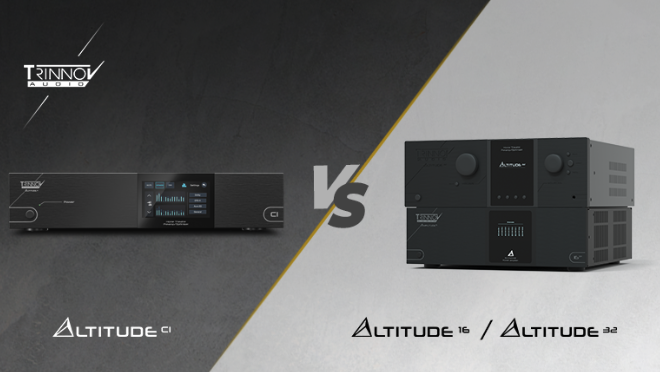
Trinnov Altitude: The Strategic Choice Between Analogue (16/32) and AoIP (CI)
Altitude16
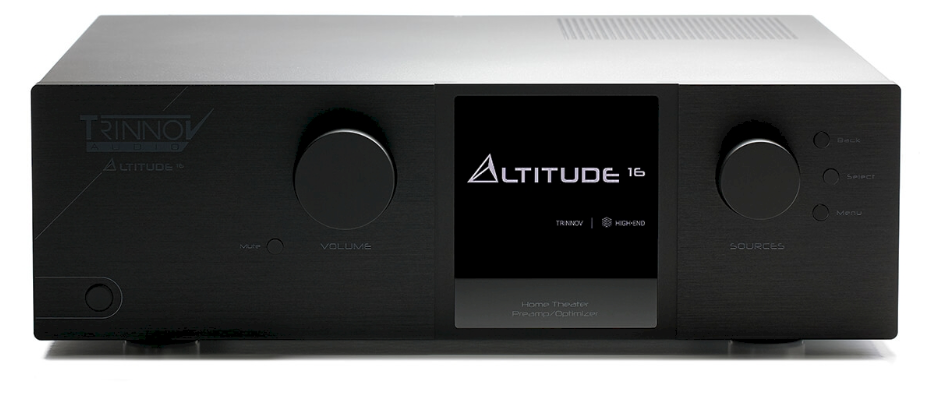
- 16 analogue channels (expandable to 20), with a strong focus on a high number of analogue outputs.
- Dedicated home theaters (bijvoorbeeld 9.1.6 en 11.1.8) tot 20 kanalen. Maximale compatibiliteit met analoge versterkers.
Altitude32
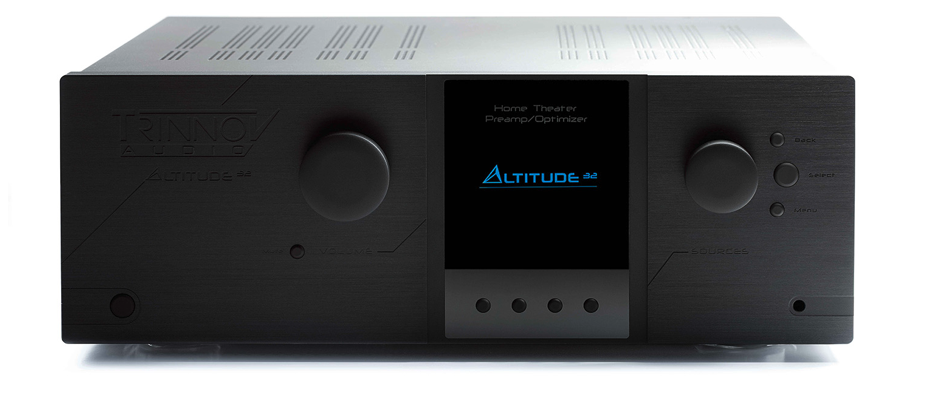
- Scalable from 8 to 32 analogue channels (via DAC cards), offering exceptional flexibility and future-proof expandability.
Designed for cinemas and large-scale audio systems (22 to 32 channels) requiring analogue connectivity and the flexibility to expand over time.
AltitudeCI
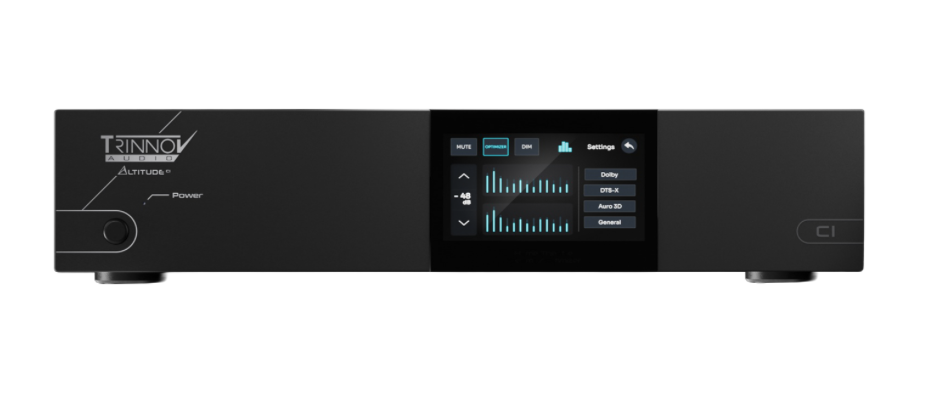
- 8 to 32 channels (in 2-channel increments), expandable to 64 channels (from 2026). AoIP (Dante/AES67) as the primary platform, with 8 analogue outputs included.
- Ideal for projects using AoIP-compatible power amplifiers (including the Amplitude16 with Dante) and installations that demand maximum scalability and rack efficiency. Suitable for DCI-grade cinema applications.
How do you choose between the AltitudeCI and the Altitude16/32?
The first deciding factor is not performance, but infrastructure.
If your project includes analogue components and you prefer traditional cabling, the Altitude16 and Altitude32 remain the safest and most flexible choice.
If, on the other hand, your project is designed around AoIP, the AltitudeCI is the most future-ready option.
The required channel count is the second key factor in the selection process:
8–20 channels → Both the Altitude16 and the AltitudeCI are suitable options.
20–48 channels → Both the Altitude32 and the AltitudeCI are valid choices.
48–64 channels → The AltitudeCI is the only available option.
The Altitude32 also serves as a scalable entry point: a system can start with as few as 8 channels and be expanded up to 32 channels through the addition of DAC cards.
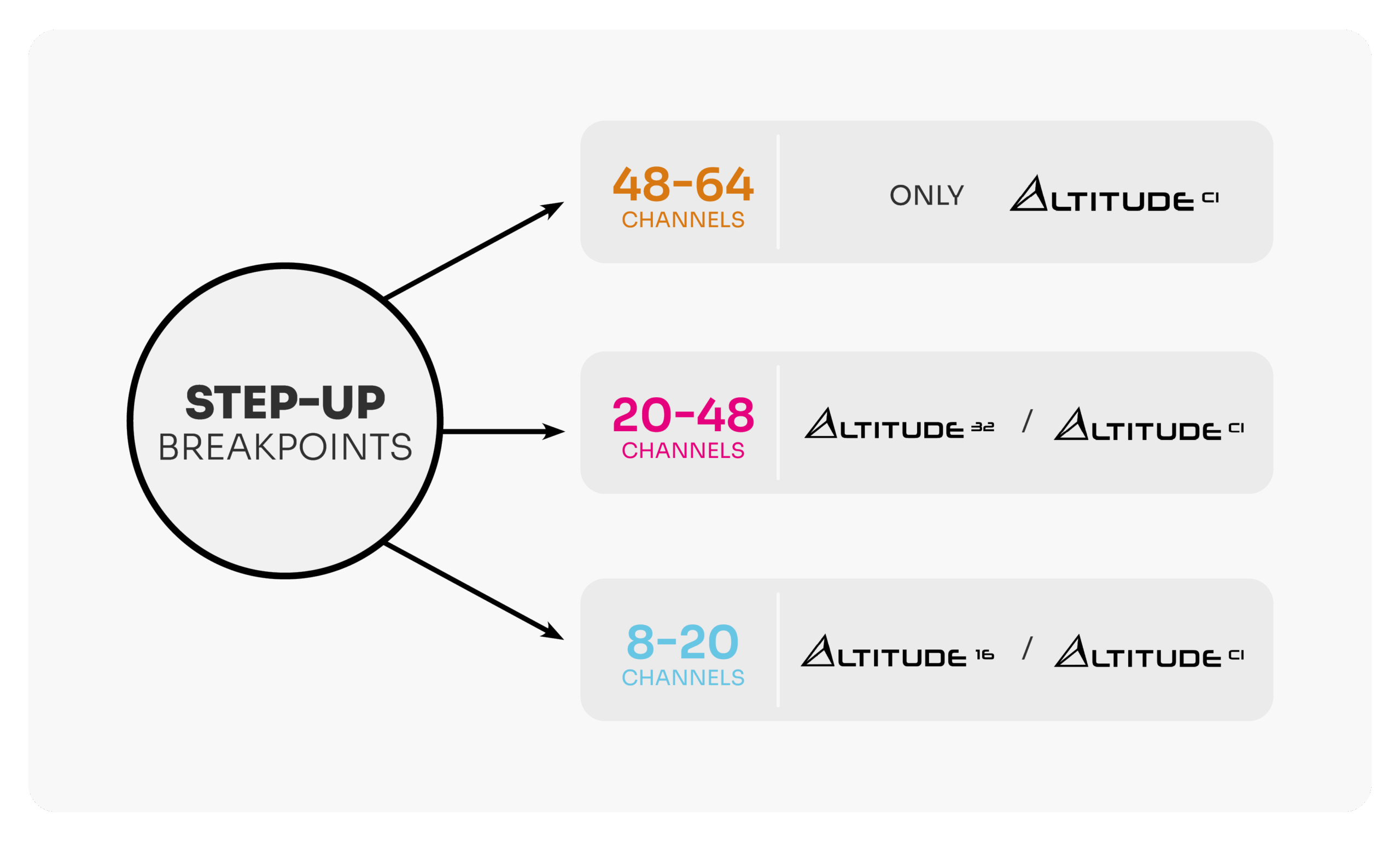
The key technical differences between the AltitudeCI and the Altitude16/32
A few differences in technical specifications may be enough to determine your final choice:
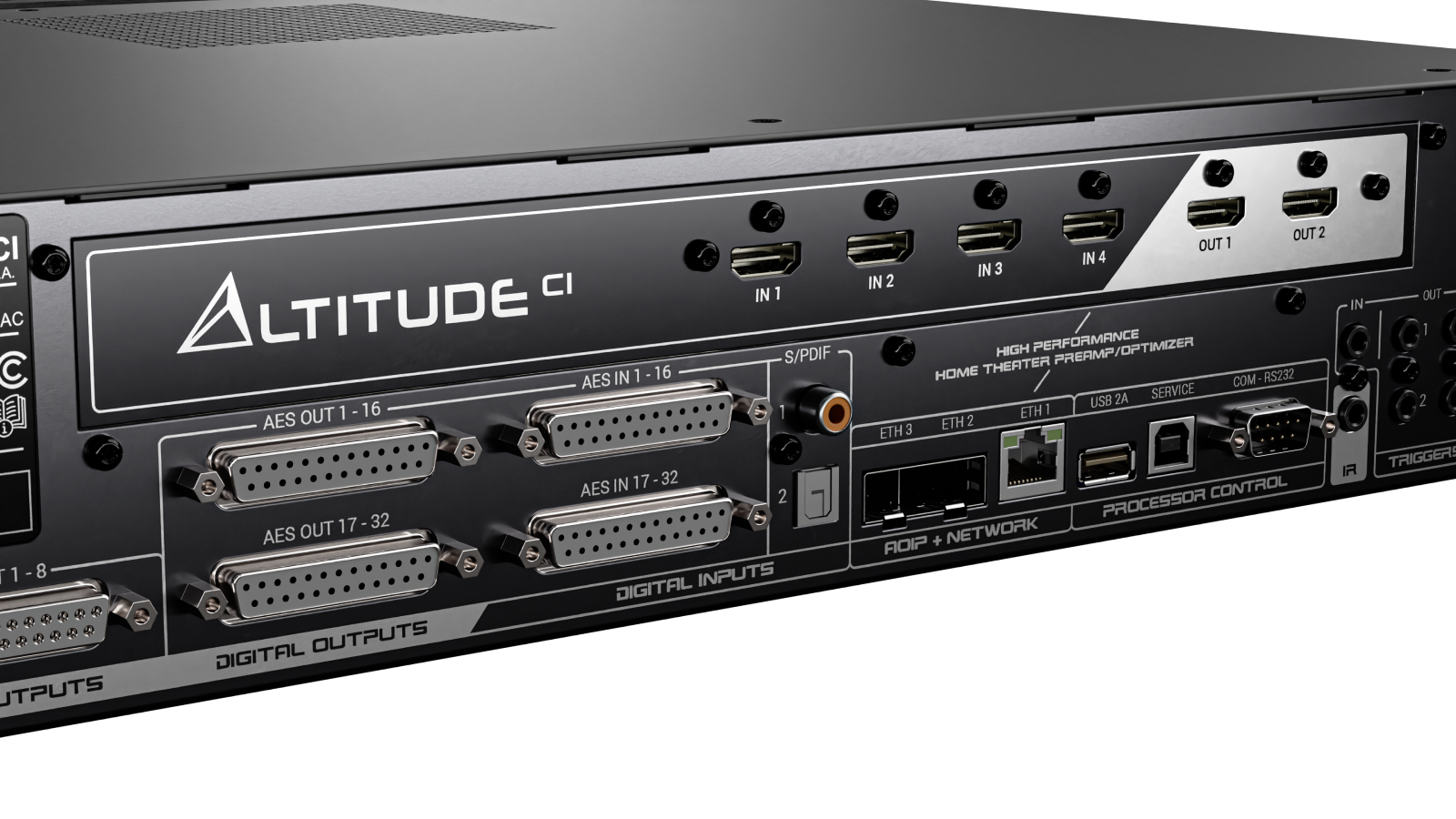
- Outputs: The Altitude16 and Altitude32 offer extensive analogue outputs (XLR). The AltitudeCI provides only 8 analogue outputs, but compensates with added flexibility through AoIP and AES/EBU connectivity. HDMI: The Altitude16 and Altitude32 feature 8 HDMI inputs.
- The AltitudeCI features 4 HDMI inputs, which is typically sufficient in Custom Integration (CI) environments where external video matrices handle source switching.
- Sampling Rate: All Altitude processors handle audio at its native sampling rate (up to 96kHz/192kHz). It is important to note that when using AoIP, the limitation lies within the network itself; Dante and AES67 streams are typically limited to 48kHz. This is a network constraint, not a limitation of the processor.
- 3D Microphone: The Altitude16 and Altitude32 use the previous generation of self-powered 3D microphones (XLR3 or XLR5), requiring the calibration file to be uploaded manually. The AltitudeCI, on the other hand, requires Trinnov’s new EtherCON-based 3D microphone. This microphone is powered directly by the processor and automatically loads its compensation file.Important: The two microphone generations are not compatible with each other, an important consideration for integrators managing mixed inventories.
Conclusion: Infrastructure Determines the Choice — Not Performance
All Altitude processors deliver the same Trinnov sound quality, feature the same exclusive technologies, and share the same redesigned user interface. As a result, the choice between models is not driven by audio performance, but by system infrastructure and amplifier selection.
- Choose the Altitude16 or Altitude32 if you want maximum flexibility in amplifier selection, require a higher number of analogue outputs, and prefer traditional cabling.
- Choose the AltitudeCI if your system is built around AoIP and rack efficiency is a priority.
Whichever model you choose, you are investing in one of the most advanced AV processor platforms available today, engineered to deliver uncompromising performance for years to come.
DEALERS
A Sound Connection
Quartz AV works with a trusted, professional, experienced and dedicated independent selective dealer network.